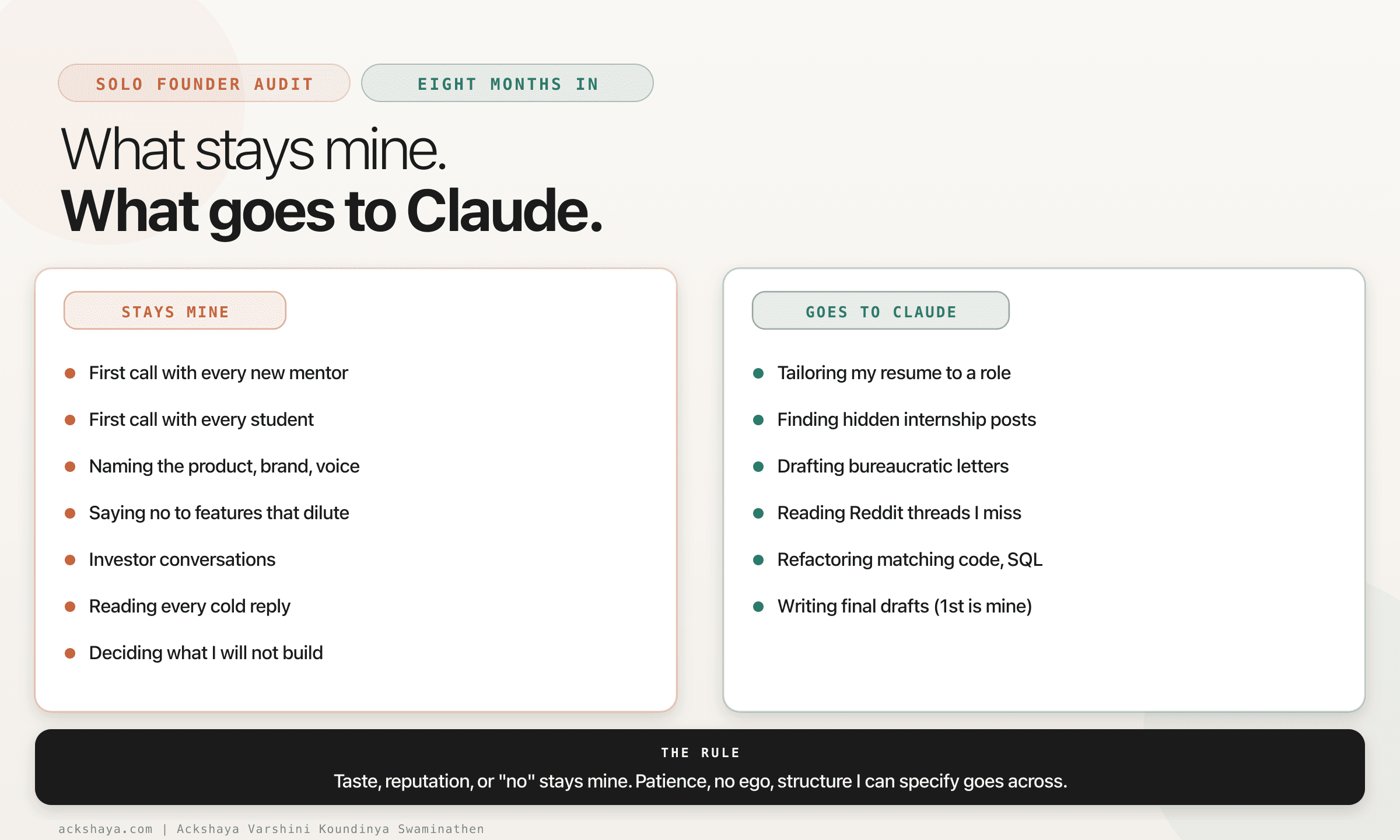
Eight Months In
I am eight months into building solo. I have not been alone at my desk in any of them.
This Saturday I sat down and audited what I still do myself versus what goes to Claude. Two columns. One rule. The audit is below. The rule is at the bottom. The how-to for every Claude bullet is in between.
What Stays Mine
Each of these has a one-line reason it cannot leave my desk. The reason matters more than the bullet.
First call with every new mentor
Trust is set in the first 10 minutes. Nobody else can do that for me.
First call with every student
I want to hear what they tried before they signed up. That shapes the product.
Naming the product, brand, and voice
Naming is taste, and taste compounds. Outsource it once and the brand drifts forever.
Saying no to features that would dilute the product
A 'maybe' from me costs the next eight weeks of someone else's roadmap.
Investor conversations
An investor is buying the founder before the company. Outsourcing the conversation defeats the point.
Reading every cold reply and writing the second message
First reply is template. Second reply is where retention is built.
Deciding what I will not build
The refusal is the work. Claude can list 50 ideas. Only I can kill 47 of them.
What Goes to Claude
Every bullet below is a real workflow I run. Where I have already written up the full how-to in another article, the link is at the end of that bullet. The rest are short enough to describe in place.
Tailoring my resume to a specific role
I wrote a resume-tailor skill months ago. Paste the JD, paste my source resume, ask for the tailored version with the specific bullets reordered and softened where needed. The skill stays the same; the output changes per role.
Finding hidden internship posts on the LinkedIn feed (not the /jobs page)
Apify MCP plugged into Claude Desktop, one prompt that scrapes feed posts where a hiring manager (not a recruiter) is posting, ranks by recency and low like count, and returns a ranked spreadsheet. Full setup and the verbatim prompt are in the linked walkthrough below.
Read the full walkthroughDrafting university and accelerator bureaucratic letters
Letter of intent, advisor confirmation, internship verification, OPT employer letter. I keep a small folder of templates, hand Claude the template plus the specific facts (dates, names, org), and it produces a clean draft I edit by hand. The structure is repeatable; the facts are not.
Reading Reddit threads I would never get to
Apify or a simple web fetch hands Claude the top threads from r/firstgen, r/csMajors, r/ApplyingToCollege from the last week. I ask for: dominant pain points, recurring questions, posts where the OP felt unheard. It comes back with a one-page synthesis. I read that, not 200 threads.
Refactoring matching code and writing SQL
Claude Code in the repo. Open the file, give it the new shape I want, watch the diff. For SQL, I describe what the query should answer ("which students went silent in the last 30 days and had at least one mentor reply") and it writes the joins. I read every diff before merging.
How the matching engine got builtWriting the final draft of this kind of post
The first draft is always me and my thoughts. Bullets, fragments, the rough arc, the actual sentences I would say out loud. Then I hand that to Claude and ask for the final draft. It tightens, sequences, and cuts. The voice is mine because the source was mine. Claude is the editor, not the author.
Related Resources
I Wrote a Prompt, Not a Search.
The Claude + Apify MCP loop that finds hidden internship posts on the LinkedIn feed.
Builder LogThe 3 AI Agent Frameworks I Tested
How the matching engine refactor work actually got done in Claude Agent SDK.
Founder NoteTwo Years Ahead: The Mentor Rule
Why the first call with every mentor stays mine, and why it matters.
Follow on LinkedIn for the next audit and the rest of the build-in-public posts
Follow on LinkedInMore resources coming soon
← Back to all resources