The Recurring Thread
Every couple of weeks the same thread shows up on r/firstgen. A high school senior, parents who have not been through American college admissions, a counselor who handles 400 students. They post their college list. They ask if anyone has actually been admitted to one of these places. They are not asking for inspiration. They are asking for someone who remembers what the supplement asks.
The replies are predictable. Half are encouragement. Half are alums sharing what their major taught them about industry. None of it answers the question.
The thread keeps appearing because the people who can actually help are not in the room.
Counselor vs Sophomore
The two people closest to a first-gen applicant are usually their counselor and, if they are lucky, a current student two years older from their high school. They give wildly different kinds of advice.
Your high school counselor
The generic college list voice
- Has 400 other students this year.
- Recommends the same essay topics they did in 2018.
- Has not read this year's supplement prompts.
- Office hours by appointment, two weeks out.
- Will not text you back at 11pm.
A sophomore at your target school
The next-rung voice
- Wrote the same supplement 18 months ago.
- Knows which essay drafts the AOs liked.
- Just navigated the financial aid portal.
- Knows which dorm has the bad heating.
- Will text back at 11pm because they remember 11pm.
Why “Two Years Ahead” Is the Right Gap
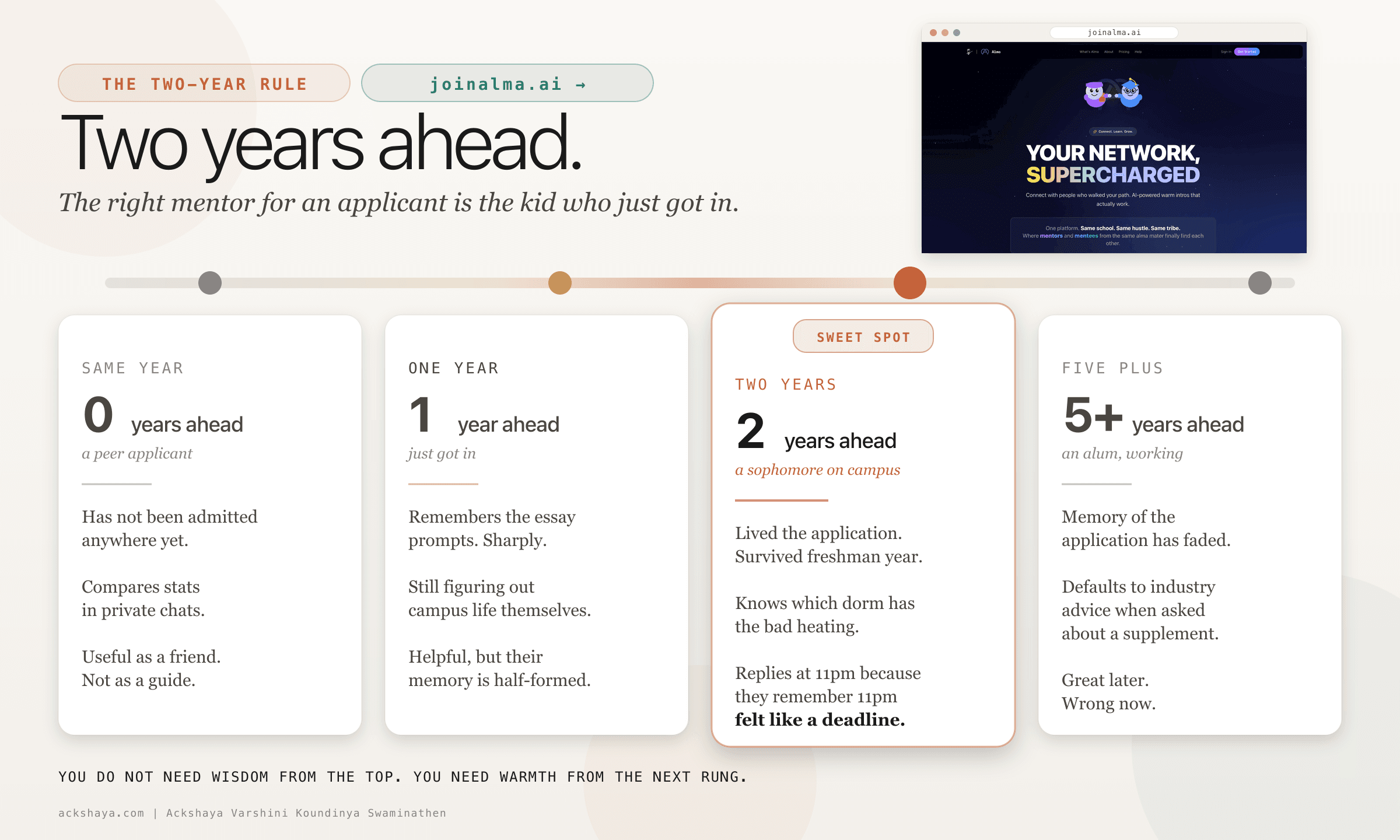
The number is not arbitrary. One year ahead is too close. They just got in and they are still figuring out where the dining hall is. Five years ahead is too far. Their memory of the application is mostly the relief of finishing it.
Two years ahead is the gap where someone has lived through every decision their mentee is about to make and still remembers it as something they did, not something that happened to them.
- Essay timing. They remember which drafts of their personal statement got cut and why. Not in the abstract. The actual sentences.
- Interview memory. They remember the actual questions, not the framework someone wrote a book about. Including the ones the alum interviewer went off-script with.
- Financial aid quirks. They just used the new portal. They know which document the school asks for that nobody warned them about.
- Dorm specifics. They know which RAs check the floor on Friday nights, which dining hall closes at 8pm, which professor's intro class is brutal even though the syllabus looks fine.
Related Resources
F-1 to Founder: The 36-Month Playbook
OPT, STEM OPT, and the founder path, phase by phase, for international students.
Builder LogThe 3 AI Agent Frameworks I Tested
The Claude Agent SDK build that powers Alma's matching engine today.
Technical Deep DiveUsing Claude to Debug Hydraulic Simulations
How structured prompts found a buried 10x coefficient error in 90 seconds.
Follow on LinkedIn for more notes from building Alma in public
Follow on LinkedInMore resources coming soon
← Back to all resources